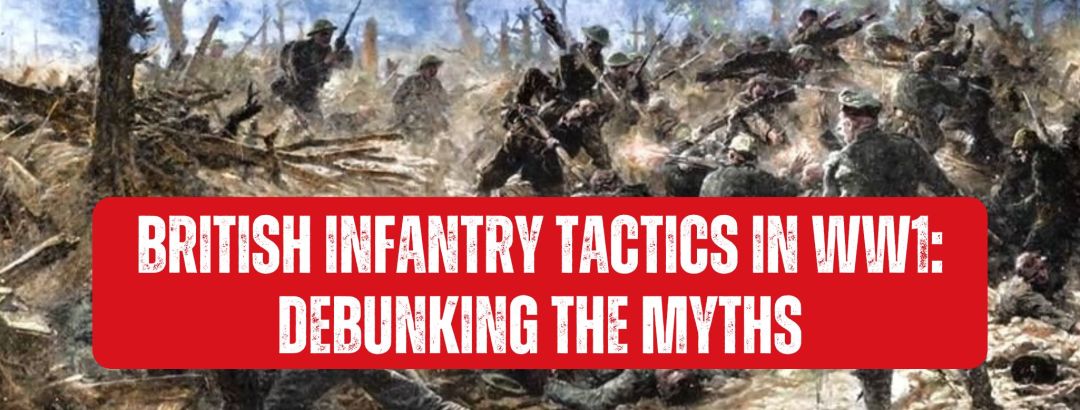
When we think of World War I, the image that often comes to mind is one of young soldiers walking in waves into a storm of steel, commanded by generals who seemed more interested in champagne than strategy.
We’ve all heard the stories: the British army was slow to adopt new technologies and tactics, and the generals were out of touch, sitting safely behind the lines. These are the tales that have permeated our collective memory, reinforced by countless books, movies, and TV shows. But what if I told you that this popular narrative is misleading? What if the British and Empire armies were actually dynamic, forward-thinking institutions, quick to embrace new technology and adapt their tactics as the war evolved?
The Reality Behind the Myths
The British army at the start of WW1 was small by European standards, though not as tiny as it is today. This army had learned valuable lessons from the Boer War (1899-1902) in South Africa, which led to significant reforms in tactics, equipment, and administration. By the time the British army marched to war in 1914, it was the best-equipped and trained force ever to leave British shores. Their musketry was exceptional; famously, they could fire 15 aimed rounds a minute, inflicting devastating casualties on an attacking force.
However, the early battles of Mons, Le Cateau, and Ypres saw these pre-war regulars nearly wiped out, fighting a modern, industrial war for which they were unprepared. As the war transitioned from a war of maneuver to trench warfare, the British, like all the combatants, found themselves in uncharted territory. A new army was needed, one that could fight in a far more complex battle space than the world had previously known. Lessons had to be learned quickly.
Adapting to the Trenches
Trench warfare wasn’t new—it had been used in sieges for centuries—but machine guns and artillery had changed the game. In 1915, much of the heavy lifting was taken up by territorial units, roughly equivalent to the American National Guard. While 1915 didn’t bring any major breakthroughs, the battles of Neuve Chapelle and Loos showed promising signs of tactical evolution.
One such innovation was the creeping barrage, where artillery created a line of shellfire just in front of the troops, moving forward like a shield so soldiers could advance in its wake. The British also began to understand the use of heavy machine guns, like the Vickers, for indirect fire tasks—firing at targets that couldn’t be seen directly. Additionally, aircraft began to be used in numbers, gas was incorporated into the arsenal, and new weapons like grenades and the Lewis Gun, an air-cooled light machine gun, were introduced to provide infantry sections with added fire support.
At this time, the platoon, typically commanded by a Second Lieutenant, became the tactical unit of choice, with each platoon having a specific role during an assault. These roles included fighting, mopping up, and support, reflecting a more sophisticated approach to warfare.
The Somme: A Hard Lesson
The first day of the Battle of the Somme on July 1, 1916, remains the bloodiest in British military history, with 57,000 casualties, including 20,000 dead. But contrary to the myth that the operation was hastily thrown together, it involved serious planning and staff work. Unfortunately, the artillery bombardment failed to cut the German wire, and too many rounds were duds that didn’t explode. Deep German bunkers and well-entrenched machine guns remained intact, and there wasn’t enough cooperation between the infantry and artillery. The fire plan wasn’t flexible enough to adapt quickly to events on the ground.
Paddy Griffith, in his book Battle Tactics of the Western Front, points out that the real mistake of the high command was continuing the assault even when it was clear it was failing. They stubbornly hoped to snatch victory from the jaws of defeat when a reassessment and a change of plans would have been more beneficial. These lessons were hard learned at a terrible cost in lives. But as Charles Carrington wrote in his book Soldiers from Wars Returning, “The British army learnt its lesson the hard way during the middle part of the Battle of the Somme, and for the rest of the war was the best army in the field.”
Innovation and Adaptation: The SS143 Manual
One of the most important developments following these lessons was the publication of the SS143 manual in February 1917, titled Instructions for Training Platoons for Offensive Action. This manual encapsulated much of the knowledge gained from the war’s early years, particularly in weapons use. For example, while grenades had become a favorite weapon of the infantry, they were recognized as slowing down the assault. Some officers believed that relying too much on grenades encouraged soldiers to avoid closing with the enemy, losing the initiative.
The new tactics described in the SS143 manual envisioned platoon attacks in two waves. The first wave would consist of maneuver sections—rifles and advanced scouts to the left, hand-bombers to the right—followed by the firepower elements, such as rifle-grenades and the Lewis gun. The platoon HQ would be positioned centrally between these lines. Upon contact with an unsuppressed enemy, the firepower line would attempt to neutralize them while the maneuver line moved forward, especially to a flank. This approach suppressed the enemy with fire from the front while overrunning them with bayonets and bombs from a flank—a precursor to the modern “fix and flank” tactic.
The SS143 manual also emphasized flexibility and local initiative, drilling into officers and men the importance of thinking for themselves and making quick decisions on the battlefield.
Paschendaele: The Most Sophisticated Plan
Fast forward to 1917 and the Third Battle of Ypres, also known as Passchendaele. Despite its reputation for mud, blood, and futility, this battle probably represented the most sophisticated of all the BEF’s attack plans during the entire war. The biggest problems arose from a six-week delay that coincided with terrible weather, turning the battlefield into a quagmire. The choice of General Hubert Gough as army commander was also a mistake, but when General Herbert Plumer replaced him, the tide turned.
Plumer introduced a ‘bite and hold’ strategy, setting limited objectives always within range of artillery support. Troops would dig in once they reached their goals to prepare for counterattacks. This approach was more successful, especially during the middle stages of the battle, with significant progress made at places like Broodseinde Ridge. However, the battle should have been called off once the mud became too bad. Instead, it led to a political crisis that nearly cost the Allies the war.
German Stormtroopers: Not So Special After All
The German stormtroopers, often portrayed as elite forces, were brave but not as innovative as often suggested. As Paddy Griffith points out, they were simply using tactics the British had been employing since the Battle of the Somme. SS143 was essentially a stormtrooper handbook. The value of these tactics was clearly seen in August 1918 when British and Empire troops counter-attacked and swept all before them. The Germans, by then, were exhausted, and their army lacked the tactics and training to maintain the offensive.
The British army, on the other hand, had become a modern force, with each platoon wielding incredible mechanical power and a deep understanding of the tactics needed to defeat the enemy. Individual units continued to innovate, with formations like “worms,” blobs, and diamond formations becoming the norm as the war evolved back into a war of maneuver.
Conclusion: The True Legacy of British Infantry Tactics
Of course, many factors contributed to the German defeat in WW1, and British stormtrooper tactics weren’t the sole reason. However, they were crucial in breaking through the formidable German defences and helping to bring the war to a close. The British army’s embrace of tanks, aircraft, and the creation of the Machine Gun Corps highlighted their willingness to innovate.
Far from the popular myth of “lions led by donkeys,” the British army of WW1 was a force of tactical innovators. At all levels, from the trenches to the high command, they were willing to experiment, adapt, and find new ways to achieve what infantry does best—closing with and defeating the enemy. It’s time to give them the credit they deserve for their role in shaping modern warfare.

 redcoathistory.com