
The redcoats. Possibly the most distinctive soldiers in history.
Yes, other nations had red-coated troops. And yes, British soldiers have worn other colours over the centuries. But that bold, brash, unmistakable scarlet has become the enduring image of the British Army—especially the Empire-building kind.
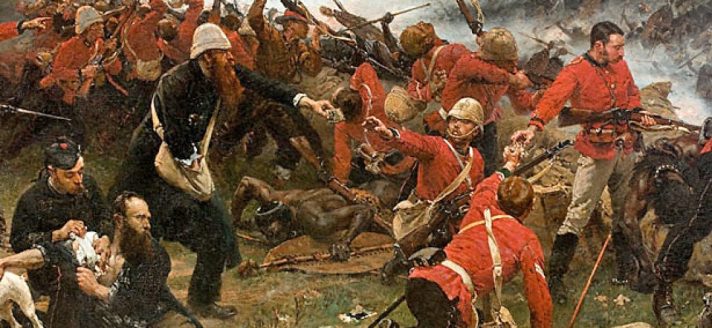
These days, you’ll mostly spot the red coat on parade—worn by the Guards or for ceremonial purposes. But for nearly two centuries, it was the everyday fighting gear of the British infantryman.
Given that I named this entire channel and podcast after it, it’s high time we took a proper look at where the red coat came from, why it stuck, and how it earned its reputation.
A Uniform That Meant Business
Unlike the cavalry, whose uniforms gradually drifted into “look-at-me” absurdity, the red coat of the infantry was simple, standardised, and—dare I say—practical.
At least at first.
Its simplicity wasn’t just a matter of fashion. On the smoky, chaotic battlefield, bright red allowed commanders to spot their own men quickly. And psychologically, there was comfort in seeing those solid lines of scarlet-clad heroes standing firm beside you.
It wasn’t just visibility either. The red coat was feared.
So, Why Red?
Red has long been a military colour. The Romans are often depicted in it. Yes, yes, they wore other colours too—but the image stuck.
In English military tradition, red makes an early appearance in the late 15th century with Henry VII’s Yeomen of the Guard. But it’s a Welsh thing, actually—his nod to the red dragon of his homeland. So, in a twist that will both amuse and infuriate Welsh nationalists, England’s most iconic military uniform has Welsh roots.
Elizabethan troops wore red in Ireland. But back then, there was no consistency. Regiments wore whatever their colonels fancied, which led to chaos—especially in the English Civil War, where red coats turned up on both sides.
Standardisation and the New Model Army
That all changed with the New Model Army. Parliament wanted a professional force—disciplined, uniformed, and reliable. Enter Venetian red—a muddy, brownish red chosen not for its flair, but because it was cheap and colourfast.

The dye, originally from madder root and later from cochineal, didn’t fade as easily in the sun—an important detail when you’re standing under a blazing Indian or Egyptian sky. It also held its colour through multiple campaigns.
And the first time the New Model Army’s red coats showed Europe what they could do?
1658: The Battle of the Dunes
English redcoats, fighting with the French (I know, try not to shudder), stormed the Spanish-held Dunes near Dunkirk. Major-General Thomas Morgan and Sir William Lockhart led the charge. Lockhart’s men sprinted up a 150-foot sand dune and battered the Spanish in brutal hand-to-hand fighting.
It was a turning point. Dunkirk fell. Charles II stayed in exile. And England—redcoats and all—announced itself as a serious military power.
Blood, Dye, and Mythology
There’s a popular myth that red was chosen because it masked blood. While it’s not entirely untrue, that wasn’t the main reason. But it certainly added to the aura: stoic, invincible, unconcerned by a few musket balls.
As the 19th century wore on, style began to beat practicality. By the time of the Crimean War, the uniform was uncomfortable and ill-suited to combat. So, in 1855, it was redesigned. Eventually, two versions emerged: a thick tunic for parade, and a lighter jacket for marching and fighting.
Still, it was hardly ideal. Too hot in India. Too cold in Crimea. Yet it endured.
The Empire Wears Red
The red coat wasn’t just for Britain. Canada, Australia, New Zealand, South Africa—all wore it. So did colonial units like the West India Regiment.

The Honourable East India Company also issued red to its European and native troops. And you can still see echoes of the red coat in ceremonial units across the Commonwealth—from the President’s Bodyguard in India to Caribbean nations’ parade forces.
Towards Practicality: Grey, White, and… Eventually Khaki
By the late 19th century, the army began to adapt. Campaigns in India, Abyssinia, and West Africa demanded lighter uniforms: white drill for day, greatcoats for night, and even grey tweed for the Ashanti campaign.
Of course, bad decisions still abounded—like Major General George Burrell, who made his men wear full red serge while doing manual labour in 40°C heat during the First Anglo-China War. Brilliant.
Khaki Makes Its Move
The Corps of Guides in India wore khaki from 1848, but most of the army took decades to catch on. In some campaigns, like the Mahdist War, red was still favoured for its psychological impact. Soldiers were ordered to wear it to intimidate the enemy—even if it made them easier to shoot.
The last official use of red in battle came in 1885 at the Battle of Ginnis. After that, red was strictly for show. And even then, it clung on. Some troops still wore it on patrol as late as the 1890s.
By 1902, khaki became official British service dress. But the red coat never truly disappeared.
A Symbol That Endures
Today, the red coat lives on in ceremonial dress and parades across Britain and the Commonwealth. To many, rightly or wrongly, it remains the visual symbol of the British Empire.
And say what you will about its practicality, it certainly looked the part.
Like This Kind of History?
If you enjoyed this deep dive into British military dress—and want to help keep this kind of content coming—consider supporting my work on Patreon or by grabbing some of the gear from my merch store.
Every purchase helps support the study (and celebration) of British military history. And let’s face it—your wardrobe could use a bit more red.
Special thanks to Dr Chris Brice for co-writing and researching this episode/post.

 redcoathistory.com